Sunday, May 3, 2015
Sgraffito... Norwegian style
I am soon off to the Mid-western part of the USA to demonstrate and teach Early American Pottery for 3 months. I specialize in Yellow Ware, but this is hard to do on the road, as I need a lathe to decorate the feathering patterns, that would be too much to cart around. So I work a lot in miniature and demonstrate pottery by small "samples". I especially like tiny face jugs as my fair-goers do.
The mid-west in the 1800s, was populated by a lot of Scandinavians and Germans. The Germans have kept a low profile due to the wars going on in Europe in the early 1900s. My own great grandfather came from Germany to New York City in the late 1800s. And it was the Germans who brought over the Sgraffito style of pottery to the USA.
Sgraffito is an old style of pottery decoration. It developed in several places in Europe at the same time. In the 1600s, potters all over Europe began to decorate their simple utilitarian clay pot with colored clays called slips. Clay comes in shades of red, yellow and white, but it can also be colored by adding oxides. Cobalt will create shades of blue, chrome shades of green. Their were several ways to decorate with these colors. Slip can be painted and "trailed" onto wares with a quill cup, applied with a sponge or a coat of color applied and decorations scratched through this top layer of color to show the clay color underneath... Sgraffito.
Germans coming to America in the 1600s brought trailing and sgraffito styles. They settled in Pennsylvania and many of our antique sgraffito pots can be traced to that area. Here in New England... not so much. New England was settled early by the English and although the English did sgraffito work back in England in the 1600s, they did little work in sgraffito here. You can find many trailed patterns from early New England. Our own local potter, Hervey Brooks from Goshen CT, did some slip trailed plates. Along the Connecticut shore, potters decorated with slips having the influence of those New York city immigrants nearby.
Midwesterners however, got a late start. Immigrants brought some pottery with them as they settled out west, but by the mid 1800s, pottery was taking a major turn. Our roads were improving and the railroad was being laid out connecting all parts of the country by an effective means of transporting clay and the finished pottery.
Industrialization. Now potters built factories and hired unskilled labor to mass produce pottery. Those simple red clay pots were replaced by china dishes and stoneware crocks. The small potters careers were basically over.
Joseph Pohl came to Minnesota in the 1860s and made red ware pots from the clay on his property. He used a simple treadle wheel and sold his utilitarian bake ware and flower pots to the locals. But less than 10 years later, Red Wing pottery opened its major operation nearby. They would manufacture thousands of crocks and dishes.
So the art of Sgraffito stayed mostly in Pennsylvania where it is still made and sought after today.
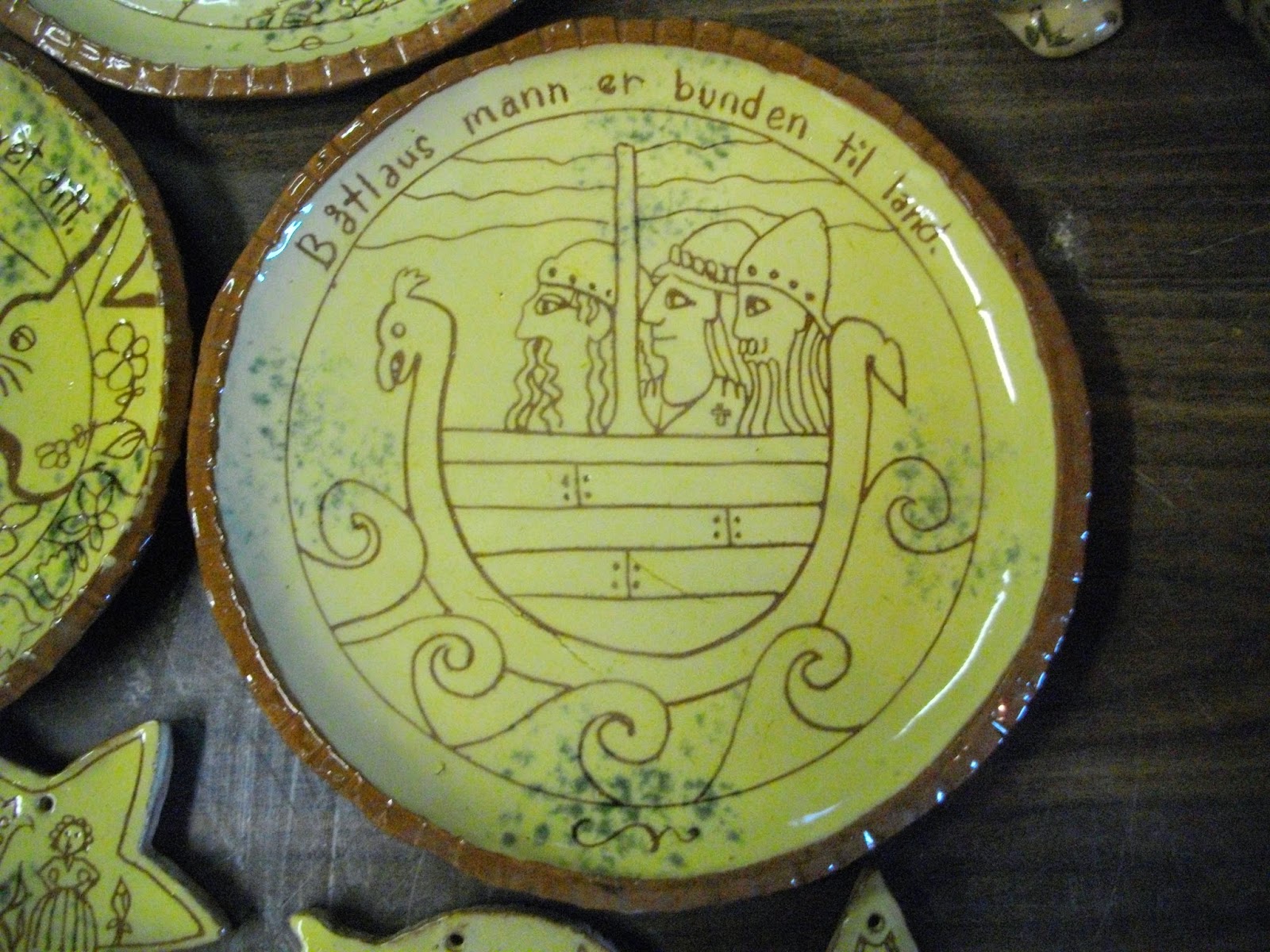
I am working out some classes in Minnesota. I would like to bring to the German and Scandinavian descendant's any other nationality, the wonderful art of Sgraffito. The two plates above have my new Norwegian flavor. Red clay is rolled out and placed over a plaster bat to firm up. In the "old" days, white clay slip would be applied to the plate, the design scratched into the white to expose the red clay underneath and a coating of lead glazed applied. When fired in the kiln, the lead and oxides in the clay would turn the white slip to a lovely yellow. Nowadays, we can use lead free glazes, but we must tint the white clay yellow with oxides to replicate the old wares. A dab of copper green is applied for variation.
The Norwegian themes of Vikings, boats and the fairy tale of Billy Goat Gruff and the troll work up nicely.
Students in my class will make up some cookie cutter ornaments to practice the technique. Then they will be working up plates with drawings of their own creation. Below are a couple of other examples. For those who may think they are not artistic, the cookie cutter rabbits (or other shapes) can be traced and embellished to create a pleasing plate.
Anyone wishing to learn more about taking a class in the art of Sgraffito can contact me on this blog or www.eastknollpottery.com
Come and try out a wonderful old style of pottery decoration and create an heirloom for future generations!
Thursday, March 19, 2015
Clay and Moonshine
| Buford |
I spend some time down south at county fairs. It seems that face jugs are still very popular down there. There are theory's about why face jugs became so popular. Some say the slaves used them to mark graves, some say they were made to scare the children away from the contents of moonshine. I think that slaves probably did introduce the idea, but face jugs are just plain fun to make and super cool to have on your shelf and to offer guests a swig.
I just found the BBC series of farms in WWII. Wartimes farm episode 3 has a tile machine. That caught my interest. Anything to do with clay, the simpler and primitive the better for me, and I have to see it. In this episode, the staff is reviving an old tile making machine using a gas engine and clay they seem to have dug up nearby. I wish I could see an hour or two of this process, but we are only shown a few minutes. They are mixing the clay with their feet, shoveling it into the machine and pressing it through a slot. Out come primitive red clay tiles that they further work cutting into slabs, adding notches and holes. Then they fire them!
This is an exciting part for all you back to basic potters out there. They build the kiln of fired red brick, stack the tiles inside, seal it up with clay and sand and fire it with wood for two days. 900 degrees is their goal. Red Clay should be fired between 800-1900 degrees or so. 800 degrees will make the pieces hard and changes the chemistry so the clay will not turn back into mud when wet. Over 2000 degrees and the high amount of iron in red clay starts to turn into... iron, too hard, warped.
As for wood firing...nothing could be more grueling and exciting at the same time! It's a lot of work. You have to camp out next to the kiln. You need people to stoke the fire in shifts, constantly. You get a little bored, especially during the night.
So what do you do to pass the time? Well these guys set up a moonshine still on top of the kiln. What could be a better use of this oven? I of course would make a stew, baked potatoes, corn bread, coffee and maybe a cake, but the idea of running a still also sounds like a good idea.
And this leads back to moonshine face jugs. You probably should not drink all the moonshine as it drips out off the still on top of your kiln. You should store some for later in a really cool face jug.
I make face jugs. You can put maple syrup in them, lemonade, switchel or moonshine. They make great vases... you can stick flowers in them too. They look great on your kitchen shelf or over your fireplace. They go along with you to reenactments and Sunday picnics. You can take them camping. They make great gifts, especially for those hard to buy for men in your life.
At the top of this blog, you will see Buford. Buford was a glazing accident. He was already dipped in the tan glaze sitting on my glazing table to dry as I was dipping my famous red birds. Splash. I didn't notice the splash of red on his nose till I took Buford out of the kiln. "Yikes", I said. My first reaction, but then I thought, cool, looks like he got punched in the nose and there is a story behind that.
![]() |
| Buford with the guys... Eastern States Exposition |
Buford spent a whole year traveling around country fairs with me and his fellow face jugs. Until Billy the bronc rider and blacksmith in Winston-Salem, North Carolina met him. Billy is the one who took Buford home and named him. I think Billy talks to Buford some times. Buford is now a moonshine jug in Billy's cabin in the hills.
![]() |
| Billy and Buford |
![]() |
| http://www.ebay.com/itm/331509170717 |
![]() |
| http://www.ebay.com/itm/331509164877 |
![]() |
| http://www.ebay.com/itm/331509172438 |
![]() |
| http://www.ebay.com/itm/331509174019 |
Saturday, March 7, 2015
Make a Backstrap Belt for your Tape Loom or Band Loom
Isobel was here helping put buckles on the belts I made for my spring classes in Tape Loom Weaving.
What you need...
5 feet of warp, 38 Threads makes a belt about 2" wide. I use Peaches and Cream cotton from your local craft store. It comes in pretty colors, does not stretch, economical and soft. Same cotton for weft.
For a beam, I use a rod 15" long. You can make your belt to fit your size or add a buckle so you can adjust it later. Most are about 36" from ring to ring.
On the photo above I wrapped the ends. You cut the left over warp to about 5" split them in half and fold onto each other. start wrapping with same string with 24 to 30" pieces, overlapping ends and adding more wrap as needed. Start at the woven end, up and around and down the other side. Then wrap the two sides together near the weave and trim all thread ends that stick out.
The other end I warped onto a pop stick
with the ring attached . I wove from this end up.
Or fold the ends later. There are so many ways to finish the ends.
Just more weaving fun!
| Weaving Rogers garters at Grand Marais MN |
Saturday, January 24, 2015
Gnomes...Nisse... Elves... Dwarfs
Many Scandinavians coming to America in the 1800s headed right for the upper Midwest. It is a land of many lakes, lots of trees and very cold winter temperatures... all things that reminded the Scandinavians of their homeland. Their decendents are still there enjoying the same things as their ancestors in the old county and sharing there folk lore with the rest of us.
For the past few years, I have been demonstrating pottery making at summer fairs in Minnesota. Minnesota has 95 fairs every year. The fairs across the country are annual events where locals can show off their livestock, their produce, be entertained and have decadent food they would not have at home.
Scandinavians are also great story tellers and everywhere you go, you hear about the Nisse. The little men with the red hats.
The Barn Elf (Fjøsnissen) is a creature from Scandinavian folklore. He was often described as a short man, “no bigger than a horse’s head”, wearing grey clothes, knickerbockers and a red hat similar to what Norwegian farmers would wear.
As the name suggests, the Fjøsnisse lived in the barn. Of course, he was so shy that he was hardly ever seen, but he was a good little helper on the farm as long as the farmers treated him well. Especially at Christmas he would expect to get a large bowl of porridge and homemade beer, in return for looking after the livestock. Often the farmers would leave the leftovers from Christmas dinner on the table so the Nisse could help himself. But if farmers failed to keep him fed and happy, the Nisse would do mischief or harm to both animals and people.
One story tells that the Nisse, upon finding that the farmer had failed to put a speck of butter in his porridge, got angry and killed the farm’s best milking cow. Later he found out that the farmer had simply put the butter in the bottom of the bowl and the porridge on top. Regretting his mischief, the Nisse then went and stole the milking cow from the neighbor's farm to replace the one he killed!
Fjøsnissen was thought to have supernatural powers. His red hat was grey on the inside, and if he wore it inside out he would become so grey that he turned invisible. The Nisse was also the one responsible when anything strange or unexplainable happened on the farm. In folklore and literature he has been described as the guardian saint of the farm. Even today it is a custom to leave a bowl of porridge and a jug of beer in the barn for the Fjøsnisse.
We all know this guy in the red hat. I am not sure if Santa or just his helpers were elves.
In the 1980s, Travelocity began advertising a man named Bill who was looking for his garden gnome. The "Roaming Gnome" became the mascot of the company. A great campaign with a list of pranks and intrigues revolving around this little guy with his red hat.
People still collect gnomes for their gardens. Linda Langford of the UK has these two little elves on her front lawn.
We all know this guy in the red hat. I am not sure if Santa or just his helpers were elves.
In the 1980s, Travelocity began advertising a man named Bill who was looking for his garden gnome. The "Roaming Gnome" became the mascot of the company. A great campaign with a list of pranks and intrigues revolving around this little guy with his red hat.
People still collect gnomes for their gardens. Linda Langford of the UK has these two little elves on her front lawn.And who could forget the 7 dwarves?
Which brings us back the my obsession with the little guys in the little red pointy hats.
These are 3 of my own little pottery gnome heads.
And so, read some Nisse stories, put a gnome in your garden, make yourself a red pointy hat and...
![]() |
| Isobel, Adelaide, Meta |
![]() |
| Roger |
order a gnome at my web site or stop by my tent at any of the upcoming 2015 fairs for a gnome of your own.
www.eastknollpottery.com
Sunday, January 18, 2015
Miniature Face Jugs
Making tiny pots is not something I invented. Lots of potters still like making these little miniatures. We make them just for fun. They serve no purpose except maybe to hold tiny flowers or fruit, dollhouse decorations or just because they make you smile. And that is all they need to do.
![]() |
| www.antiquebottles.com/southeast/jul03.html Orville Seals shared his very comprehensive display of "Louisville Kentucky Mini Jugs" |
group that collects all size jugs, but as you can see, there are a lot of old tiny jugs out there to find.
Potters used them for advertising... to show shop owners what style, color and design pots they could make in a larger version and they would not have to travel around town to town in horse and buggy and lots of big, heavy, fragile pot samples..
And potters had children of their own to please and the neighborhood urchins at the potters shop as well.
I make hundreds of my tiny pots every year at shows and I am making hundreds of them in my studio this winter.
![]() |
| My bigger kiln full of tiny pots. |
Thursday, November 20, 2014
Who the Hell is Krampus?
It is a little early for Christmas blogs... but I just had to plug Krampus for my pottery sale at Regional #7 this Saturday, November 22.
I make little Krampus Jugs. I can never make enough of them.
I first heard of Krampus when I met a fellow tradesman from Minnesota. He linked me up to this video and it has become "our song". Roger plays a Krampus in the upcoming winter event in Grand Marais, MN.
https://www.youtube.com/watch?v=kOd3mW_bJUw&index=19&list=FLld5yPMyhpEQsHWkY1BjcWw
Die Seer - Ubern See.... we still don't have a translation of the song except the title... "Ubern lake".... I think.
But who is Krampus?
Krampus is the dark companion of St. Nicholas. Europeans holiday gift-giver, St Nick, gives good children gifts on December 6. Bad children are punished by Krampus, the hell-bound counterpart. He has many names, Knecht, Ruprecht, Certa, Perchten, Black Peter, Schmutzli, Pelznickel, Klaubauf... and Krampus. Krampus punishes naughty children with switches and rusty chains, sometimes dragging them to the firey place below and has been known to eat really bad children. Not a nice guy. Here in America, we have deleted this fellow from our Holiday, except for the finding of coal in our stockings occasionally.
Here are just two of peoples images of what Krampus looks like...
So celebrate the Holiday this year and remember there is a dark side to our traditions. Go buy American Crafts. Be good.
![]() |
| my krampus collection |
Sunday, November 16, 2014
Buy Connecticut made Crafts at Local Events!
My old high school, Regional #7 is having a Craft Sale this Saturday, November 22, 2014 in Winsted CT
If your budget is tight this year, or if you need some economical stocking stuffers, why not shop at your local Church, School or Civic Events? Sometimes you can buy extra mittens for grandkids for under $5.... home knitted mittens by some little old lady (that could be me), home assembled soup mixes, all kinds of cool stuff. And you will support the homemakers and crafters, the sponsor group can make some cash to keep going, and you get some great stuff you would like to make yourself if you had time.
Or, you could support Walmart....NOT.
I will be there in my booth,#78 in the gym, supporting the Agricultural Department of my school and offering some great stocking stuffer's.
| the before photo... |
and the after photo...
I will see you there.... And did I mention the Regional #7 Event is FREE and has food too?
Come out and have a nice shopping experience.
Subscribe to:
Posts (Atom)


.jpg)


.jpg)


.jpg)